Four points of reference while defending
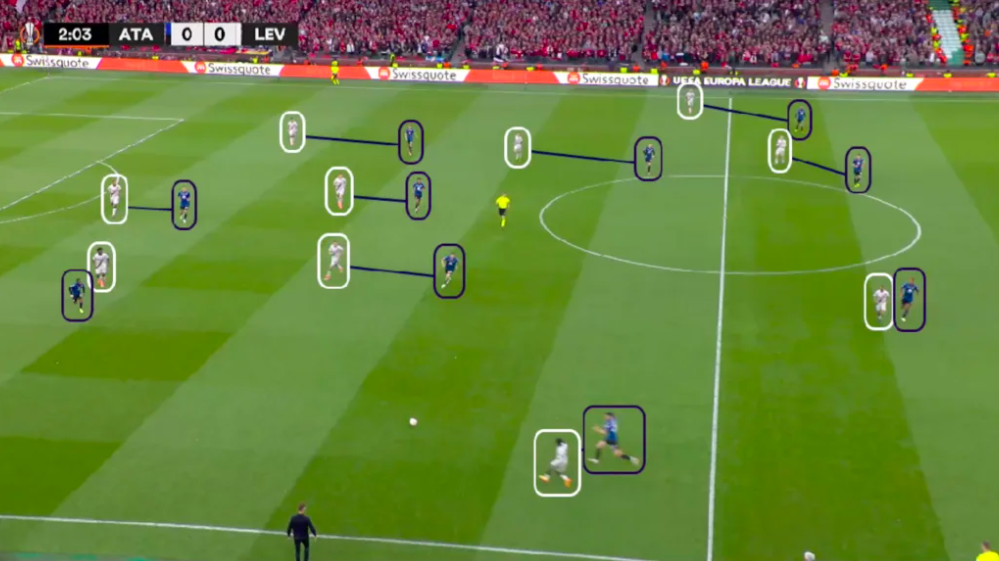
When defending, players are constantly faced with choices. Do I step out or stay put? Do I force the opponent to the left or right? Do I block a passing line to one player or mark the other? To improve the quality of such decisions, players benefit greatly from clarity from the coach. Or more specifically: clarity about the most important reference points while defending. This article focuses on the four most important reference points: the man, the ball, space, and the teammate. What takes priority in which situation?
Reference Point
In every (defensive) situation that arises on the pitch, a player consciously or unconsciously determines their position. Various factors play a role in this, such as the exact situation, the player's understanding of the game, and the coach's instructions.
If we focus on the coach's instructions, they can prioritize various "reference points" to a greater or lesser extent. This isn't a matter of right or wrong, but of personal preference and style, combined with what suits the club and the players. A key point of reference we've traditionally known in the Netherlands is man-marking: make sure your direct opponent doesn't get the ball. But the ball, space, and teammates are also important points of reference when choosing the optimal position. In short, there are four ways to determine your defensive position.
- Man-marking: where is your direct opponent?
- Ball-marking: where is the ball?
- Space-marking: which spaces do we want to protect?
- Teammate-marking: what are the distances between them?
In the remainder of this article, we will further elaborate on these four key points of reference within defending.
Man-marking
The most classic way of defending is man-marking: each player simply marks a direct opponent. This is often used by Atalanta Bergamo, for example, in the Europa League final against Bayer Leverkusen (Figure 1). In this situation, every Atalanta player simply ensures that their direct opponent doesn't get time and space.

Atalanta uses man-marking all over the pitch. The most important point of reference is therefore the direct opponent. The advantages of this defensive style are clear: everyone is clear about what's expected of them. If the execution is good, the opponent has little time or space to find solutions. The main disadvantage is also obvious: if someone fails or is outplayed, a man advantage is immediately created. At the back, it's one-on-one, which places a lot of responsibility on the defenders to win their personal duels.
Plus One
To mitigate this risk, many managers want to maintain a "+1" defense. For example, see how the Netherlands defends against England in Figure 2a. Virgil van Dijk and Stefan de Vrij are jointly responsible for defending Harry Kane and providing assists where needed, while both full-backs and holding midfielders are in man-to-man marking. This automatically means that up front or in midfield, it's a "-1" defense. In other words, they have to defend five opponents with four men (Figure 2b).


The Netherlands uses the direct opponent as its main reference point, but simultaneously maintains a +1 defense. This makes the focus somewhat less clear than "marking a direct opponent," although the defensive style in this situation is still primarily man-oriented. By pressing up front with a limited number of players, it can be a good idea to leave one opponent free, for example, the opponent's weakest playmaker. Another option is to defend from central positions with the available players (in the Netherlands example, four). Players then play against multiple opponents and keep the option open to press in different directions. If the ball goes to the side, the player on the opposite side is released, and a switch of sides must be avoided. Here too, the main focus is still the opponent, rather than the ball, space, or teammates. An advantage of this style of defending compared to "one-on-one" is that you have someone at the back. The biggest disadvantage is that you press with a limited number of players, which demands a lot from the players to win the ball.
Marking in front of the goal
Another example of man-centered defending is making agreements about preventing goals from crosses. Many coaches, even if the team plays primarily in the zone, choose to ensure that each player in their own penalty area is responsible for a direct opponent without handing over or taking over from a teammate. An example is the cross that the Netherlands delivered against England in Figure 3. At that moment, it's clear who is marking whom. Even if the Dutch players still cross, handing over is no longer the best option for many coaches. As always, in man-centered defending, the location of the ball, the space available, and the teammates are also important. Therefore, for example, a player on the opposing side will move deep inside to assist a teammate in closing down key spaces. The other three focal points (space, teammate, ball) are simply lower in the pecking order than the direct opponent in man-centered defending.

Bal oriented
A focal point that receives relatively little attention in the Netherlands—at least, as the most prominent of the four—is "the ball." The ball's location is the most decisive factor in pressing within the Red Bull style of play. Roger Schmidt, trained in this approach, tried to introduce this way of thinking at PSV through trial and error.
Jesse Marsch, former manager of both RB Salzburg and RB Leipzig, previously discussed this during a webinar: "A manager like Marcelo Bielsa, like me, is a big proponent of intense pressing. However, the way he applies it is very different. Bielsa focuses much more on man-centered pressing. From above, you see all sorts of couples on the pitch. We, on the other hand, are ball-oriented. We press towards the ball and preferably create a man advantage there."
Weak-side free
Using the ball as the main focal point during pressing often involves forcing the opponent out to the flank. There, many players develop so much pressure that it is almost impossible for the opponent to break away from it. A good example is RB Leipzig against Real Madrid in last season's Champions League. RB Leipzig forces the ball out from Real Madrid's left central defender. Then, they apply massive pressure on the flank (Figure 4a). Eight RB Leipzig players surround the ball in a space of approximately fifteen by forty meters. This, of course, means there's a lot of space on the other side of the pitch (Figure 4b). The idea of ball-oriented pressing is to prevent the ball from reaching that end. Because the pressure is so massive, the opponent ideally won't be able to switch sides. Moreover, if they do manage to switch sides, RB Leipzig has plenty of time to sprint back diagonally and get behind the ball again with the entire team.


RB Leipzig forces the ball out to the flank and defends very ball-oriented there, with eight men close to the ball. The opposing side is completely open. The biggest advantage of ball-oriented defending is clear: by creating many players around the ball, you create more pressure and increase the chance of winning possession. The disadvantage is also obvious: if the opponent does manage to get past them, a lot of space suddenly opens up.
Space-oriented
The third point of reference, space, is primarily about prioritizing certain areas on the pitch. This happens regardless of where the ball is, where teammates are positioned, and where opponents are. Certain areas on the pitch simply deserve more priority than others.
Space behind the back line
A good example is defending the space behind the back line. If the opponent has an open ball, that space deserves absolute priority. If not, the opponent can pass the ball to a player in the back and create a one-on-one with the goalkeeper. This prioritization of defending the space behind the back line is clearly evident in the game played by Tottenham Hotspur against Real Madrid a few years ago in the Champions League. When Real Madrid can play deep, their defenders defend the space behind them. They turn in, shift their weight to the leg closest to their goal (Figure 5a), and begin sprinting before the pass (Figure 5b).


Center Closed
Another example of "space" as the most important focal point is prioritizing the center over the wing. For example, look at figure 6, where Jeremy Doku keeps the axis closed for a long time before stepping out on the full-back. The main reason for this is that the space in the axis is more valuable than the space on the flank. He first ensures he keeps the ball away from the axis and then applies pressure to the flank.

Doku defends in space by first shielding the axis and only then stepping out to the flank to pressure the full-back.
In summary, the fact that most teams prioritize defending the space behind the defense, followed by the central space in front of the defense, is a direct consequence of prioritizing the focal point "space." A key reason for prioritizing these spaces is that the opponent can become dangerous there. Of course, the right balance and coordination are always key. A complete focus on the axis actually gives the opponent opportunities to break through on the flank. Arne Slot already reasoned this from the attacking perspective at the beginning of his Feyenoord career. He indicated that he prefers to attack along the axis, but that he also notices that opponents are increasingly focused on defending along the axis. This, in turn, creates more space on the flanks, as the current Liverpool manager stated at the time.
Teammate-Oriented
Now for the final point of reference: teammates. Many managers emphasize keeping the distances between them small, both lengthwise and widthwise. Consider, for example, the way Austria defended against the Netherlands at Euro 2024. Stefan de Vrij has the ball, and Austria defends in a compact 1:4:4:2 formation with the midfielders in a hollow (figure 7a). The ball passes to Virgil van Dijk, and the block shifts slightly, but maintains more or less the same structure (figure 7b). The Netherlands then plays around for a while, attacks, Austria clears the ball, and the Netherlands rebuilds. Shortly after, Austria uses an almost identical formation (Figure 7c).


The ball moves, the Netherlands uses a different formation, but Austria continues to defend in the same structure, namely 1:4:4:2, with the midfielders in a hollow. In other words, the position of an individual player is primarily determined by the position of his teammates. If you were to make one player invisible, for example, it would be easy to guess which position this hidden player occupied, because within the usual structure, there is clearly an "open" position. This applies to Austria's 1:4:4:2, but of course also to other formations, such as the 1:5:5:0 that Atletico Madrid used in phases against Manchester City in the Champions League a few seasons ago (Figure 8).

The main advantage of teammate-focused defending is that the distances between them are small, resulting in fewer gaps in the defensive organization. A potential disadvantage, however, is that there is open space between two lines (usually between the defenders and midfielders), creating space for opponents to occupy between the lines.