The seventieth minute corner kick
Marco Verbeek: "Every football coach knows that the organization of set-pieces can be compromised when substitutions are made. And I'm not talking about a one-on-one substitution like Stefan de Vrij for Matthijs de Ligt, but, for example, a triple substitution in the 68th minute because you're 0-1 down. You want to force something. Different player profiles are brought in than those you take out. In professional football, you also have players who speak different languages. And in every team, you have 'responsible' and 'irresponsible' players. In other words, to what extent is every player able to fulfill previously made agreements in an adapted mode? That's not easy for everyone. You know how it is: when the pressure is at its highest, a substitute comes on and quickly receives some instructions from an assistant coach. The assistant coach has a folder or iPad in his hand and quickly flips through all the agreements regarding set-pieces. And not unimportantly: in some situations, you also expect this substitute to relay a message to teammates regarding a changed organization. You sense that it doesn't sink in with every substitute, and that's not always due to unwillingness. Players are not coaches! I have a solution for this, and the so-called seventieth-minute corner symbolizes it. As a team, you can agree to execute a different type of corner starting in the seventieth minute. And you shouldn't take that seventieth-minute position literally; you can, of course, adjust it situationally from match to match. Make someone responsible for this. You start with a group of players beyond the far post, and the roles are assigned by one player (the captain). Everyone knows what's going to happen, except the opponent. That's an important principle for attacking set pieces anyway.

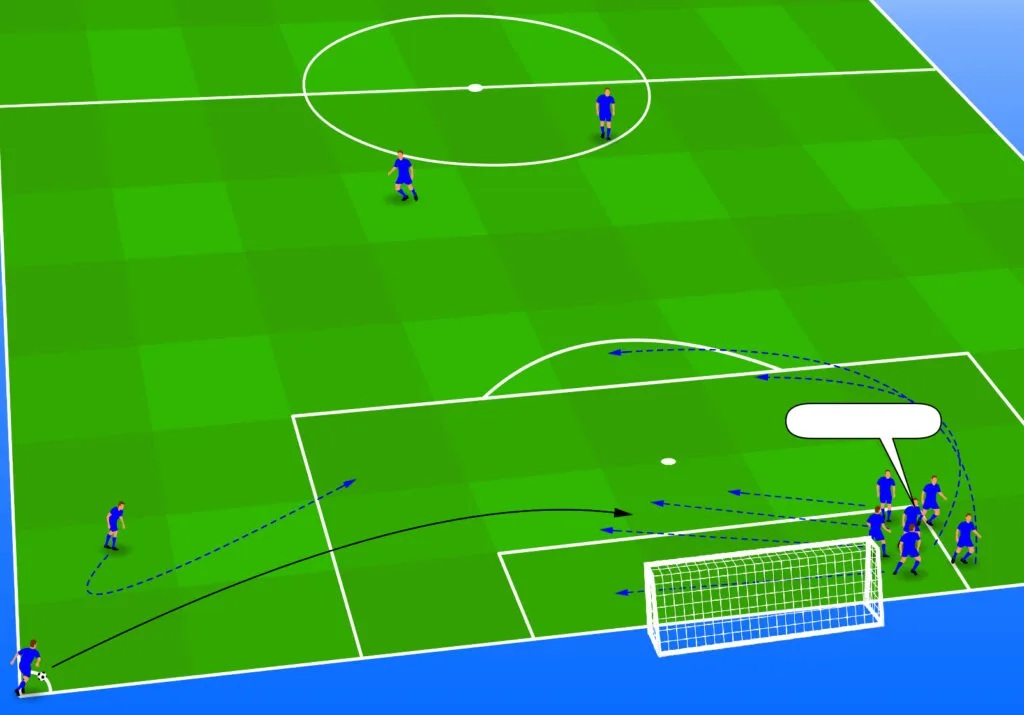
Look at the image above. We have a corner in the eighty-minute. There have already been quite a few substitutions, and we want to execute our special corner. For the sake of simplicity, I'll leave the opposition out of the picture here, because the question is how they protect themselves against this. The captain or other "leader" ensures they gather their teammates around them and communicate who goes where and what: first zone, second zone, blocks, headers, penalty line, etc. You can start beyond the far post, but of course also from another agreed-upon spot. Although there's some improvisation involved, we're still talking about a practiced routine. We know what's going to happen. This is important, because the corner taker also has to place the ball somewhere! It becomes recognizable for us, and unpredictable for the opposition because of the constantly changing roles and/or positions of your own players.
Training
"How can you focus on the attacking corner in training? Often, standard situations only come at the end of the training week, after tactical training has been completed and the lineup is already known. This way, you miss out on a lot of moments during the week. As a team, you have a standard playbook, with corners and free kicks for which you have the right players, depending on the situation. But how do you train that during the week without revealing the starting lineup? You don't take corners with twenty men either. Too many players would be standing still, often in the cold, and it also takes too much time. What I implement is dividing the group into three. The first group consists of the providers, with the guys who take the corner, the free kick, and the throw-in. The second group are the creators: players in the box, players who block or lure in the box. The third group are the target men, the finishers, the men who have to finish the ball. You can train perfectly well with the first group at the beginning of the week: kicking, throwing. A day later, you bring in the creators. You can have the finishers train separately, but you need a taker. In the final game, you can take them all together. This way, you can add set-pieces to your tactical periodization and planning. This also saves a lot of time when a substitute comes on, because everyone has received attention within their specific role, whether they're starting or not.
As a team, you can agree to execute a different type of corner kick from the seventieth minute onward.

An example of training an attacking corner kick can be seen in this drawing. The red posts represent the opposing team's zone defenders. This way, you can practice what you want to practice with a limited number of players. The yellow hoops on the ground represent the defensive blockers. Here, we're practicing a variation in which we want the circled blue player to be freed up between the penalty area and the sixteen-yard box for a shooting opportunity. To this end, four or five players run towards the zone defenders on the five-meter line just before the moment of the shot. A variation from the same organization is that the other player outside the penalty area receives the ball on the ground to take a shot from the edge of the penalty area. Note: there is only one ball, so only one player can score. The rest must provide support.'